
What Is Liquid Kratom Extract?
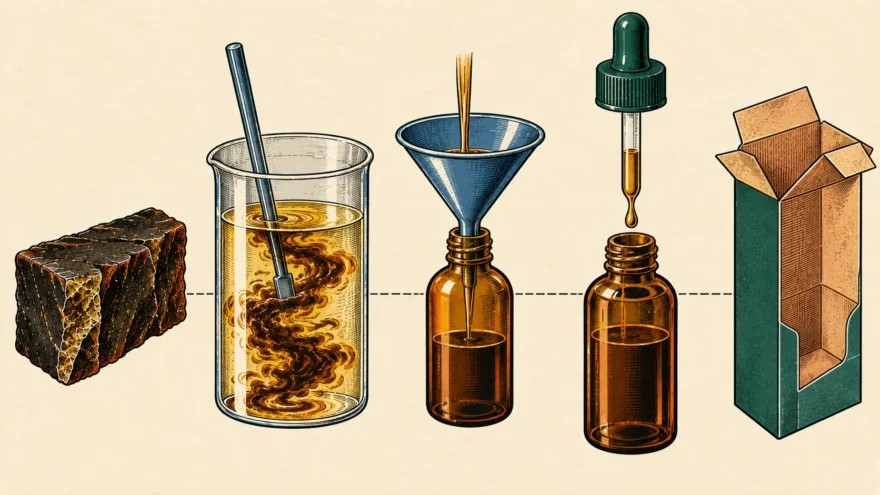
Liquid kratom extract is kratom leaf that has been concentrated and then bottled in a carrier liquid. Leaf is milled, soaked in a solvent so the alkaloids come out of it, strained away, and what is left over is boiled down to a thick concentrate. That concentrate is blended into glycerin and water and poured into small bottles. The full version of that process is on the Kratom Extract page. This page is about what happens after that, which is where the confusion lives. The name on the front of the bottle, the panel on the back and the laboratory report all describe the same liquid, and all three use different units to do it.
What is in the bottle?
Concentrate, and the liquid holding it up.
Ours are vegetable glycerin and purified water, with citric acid and ascorbic acid in the maeng da formula. Glycerin is thick and slightly sweet, and the thickness is the point, because it holds solids off the bottom of the bottle. The acid is doing chemistry. Kratom’s alkaloids dissolve more readily in acid than in plain water, which is why some producers acidify while extracting, and in a finished bottle the acid stays in and helps keep the alkaloids spread through the liquid rather than dropping out of it. Ascorbic acid is vitamin C and is there as an antioxidant.
That’s the entire ingredient list on a plain liquid. Concentrate, water, glycerin, an acid or two. A liquid extract has the shortest ingredient list of any made format, shorter than a tablet, which needs binders to press, and far shorter than a flavored drink, which needs everything a drink needs. Anything past five or six lines on a liquid label is worth asking about.
Ours are at buy liquid kratom extract, and the brand is at KR8OM.
Why buy a liquid rather than powder?
Two real reasons, and one that gets sold and should not be.
The first is that a liquid measures the same way twice. Powder does not. A teaspoon of leaf powder can be packed tight or scooped loose and mounded, and the weight of what sits in the spoon changes with it. We proved that on our own capsules: the same size shell filled with four different colors of leaf came out at four different weights. A teaspoon of liquid is a teaspoon. It can’t mound, it can’t pack, and it lands on the same amount every time, which is the one thing powder cannot promise. Kratom Capsules covers where that measurement came from.
The second is that it goes down easier. Not better tasting, easier. Kratom tastes bad in every format and concentrating it doesn’t help, so nobody is escaping the flavor. What you escape is the grit, the coating on the tongue, and the chase. Powder doesn’t dissolve in water, it floats and clumps and sinks, and a liquid mixes into water or juice and stays mixed.
The reason that does not hold up is any claim about what a liquid does differently inside a person. We’re not going to make one, and a seller who does is telling you something they cannot know about you. What is different about this format is how it measures and how it swallows. Everything past that is the same plant.
What do the numbers on the bottle mean?
Three numbers, measuring three different things.
The name is the leaf. MD25 is 25 grams of leaf equivalent, B22 is 22, MD9.9 is 9.9, B9 is 9. MD is maeng da and B is bali. It’s the clearest naming convention in the category, because the number names a quantity rather than a multiplier.
The panel is the alkaloids, stated per bottle and per serving.
The serving is 6ml on every one of them, which is what turns the bottle size into a serving count.
| Bottle | Strain | Size | Leaf equivalent | Broad spectrum alkaloids | Mitragynine | Servings |
|---|---|---|---|---|---|---|
| B9 | Bali | 12ml | 9 g | 150 mg | 85 mg | 2 |
| MD9.9 | Maeng da | 12ml | 9.9 g | 150 mg | 85 mg | 2 |
| B22 | Bali | 30ml | 22 g | 375 mg | 212.5 mg | 5 |
| MD25 | Maeng da | 30ml | 25 g | 375 mg | 212.5 mg | 5 |
Read down the leaf column, then down the alkaloid column. Both 30ml bottles hold 375mg of alkaloids. One of them is called 25 grams of leaf and the other is called 22. Identical measured content, different leaf number.
So the leaf figure is not telling you how much alkaloid is in the bottle. It describes what went into the pot, and it takes a different weight of leaf to reach the same alkaloid load depending on what that leaf was carrying that season. The leaf number is the input. The milligram number is the output. Only one of them is in your hand.
That’s the same lesson a 10x or 50x multiplier teaches on the extract page, arriving in a more honest form. A leaf equivalence figure at least names a quantity. It can’t be checked, and the milligram figure can.
Is the small bottle the same liquid as the big one?
Yes, and you can prove it with division.
150 into 12 is 12.5 milligrams of alkaloid per milliliter. 375 into 30 is 12.5. Mitragynine works out the same way, 7.08 milligrams per milliliter in both. The 12ml and the 30ml are one formula in two sizes, the way a quarter kilo and a half kilo of powder are one powder in two bags.
So the size is not a strength decision. It’s a quantity decision, and it should be compared like one. Work out the cost per serving rather than the cost per bottle, because the two bottles hold different numbers of servings and the shelf price doesn’t mention it.
How many servings are in a bottle?
Two in the 12ml. Five in the 30ml. That’s the most important sentence on this page.
The 30ml is the one to think about. It’s a tapered bottle with a narrow neck, the same shape and size as the shots sold at a convenience store checkout, and those are built to be picked up and finished. A person can pick one up, drink it, and pick up another. That habit applied to this bottle is five servings in a few minutes.
The 12ml is a small straight sided bottle and looks less like a shot, but it is two servings rather than one.
Neither bottle corrects that on its own. This is the same trap as loose extract powder in different packaging. With powder the habit is to measure with a spoon. With a small bottle the habit is to let the bottle be the unit. Both hand the measuring job to the container, and the container was never asked to do it.
This is an adult product and it asks something of the person holding it. That’s the whole reason this guide exists. Measure the serving. Don’t drink the bottle because the bottle is small.
What does the laboratory report say?
Every extract lot we carry is tested by an independent third party laboratory, and we publish the report. The report belongs to the manufacturer, not to us. We hold it, we read it, and we put it where a customer can read it too, on our lab tests page.
Here are the two liquid lots, tested for KR8OM by Cambium Analytica, an ISO/IEC 17025 accredited laboratory, reported in February 2026.
| Alkaloid | Bali lot mg per gram | Maeng da lot mg per gram |
|---|---|---|
| Mitragynine | 6.46 | 6.62 |
| Speciociliatine | 2.41 | 2.15 |
| Paynantheine | 1.35 | 1.22 |
| Speciogynine | 1.12 | 0.96 |
| Total major alkaloids | 11.33 | 10.96 |
| 7-hydroxy mitragynine | 0.00052 | 0.00075 |
| Mitraphylline | Not detected | Not detected |
Two things to take from that table, and one warning about how to read it.
Mitragynine is 57 percent of the measured total on the bali lot and 60 percent on the maeng da lot. Published figures put mitragynine at 40 to 66 percent of total alkaloids in whole leaf, and another source at 51 to 82 percent. Both lots sit inside both ranges, with the other three alkaloids underneath in the order leaf puts them in.
7-hydroxymitragynine is a rounding error in both. A 2026 study in the Journal of AOAC International measured tablets sold as kratom extract at 22 to 75 milligrams per gram of that same compound. These lots are at 0.00052 and 0.00075. Same units, same word on the box, tens of thousands of times apart.
Now the warning, and it is about units rather than quality. The report and the package both use the word serving and mean different amounts. The report’s serving column is one milliliter. The package’s serving is six. Compare the two numbers straight across and you will think the label is inflated. It isn’t. Here’s the conversion in three steps.
Milligrams per gram times the measured density gives milligrams per milliliter. On the bali lot, 11.33 at a density of 1.11 is 12.58.
The label claims 12.5 per milliliter, so that is under one percent apart.
Multiply by the 6ml serving and the lab report says 75.5 milligrams of alkaloid and 43.0 of mitragynine, against a label stating 75 and 42.5. Under one percent apart again.
That’s what a label with a test behind it looks like. The number on the front is not a slogan. It’s a measurement somebody made, and the document that made it is published rather than described.
What does broad spectrum mean?
Our packages say broad spectrum. It is worth knowing that no standard defines the phrase, on a kratom label or anywhere near one, so on its own it is a description rather than a specification.
What it is reaching for is the idea that extraction pulls the leaf’s whole alkaloid group rather than isolating one compound out of it. That idea can be checked, and the phrase cannot.
The extract page gives you the test. An extract of leaf should read like leaf on a laboratory report, only concentrated, with the same alkaloids in roughly the same proportions. That’s what the table above shows: four alkaloids, in leaf’s order, at leaf’s rough ratios, with everything multiplied up. Read the report and the phrase stops mattering.
Why the 7-hydroxymitragynine line matters
On July 6, 2026, the Drug Enforcement Administration published a notice of intent proposing a threshold for 7-hydroxymitragynine in kratom material, set at 0.050 percent by dry weight, with anything above it counted as a concentrated product rather than as leaf. That proceeding was open when this page was written and nothing here states what the law is. Is Kratom Legal in the US? covers that.
The reason to mention it is that it tells you which line on a certificate of analysis the people who write the rules are reading. The two lots in the table measured 0.00005 and 0.00008 percent.
We have never sold 7-OH products and we do not defend them. What is on this site is leaf, and extracts made from leaf.
Who makes ours?
A man named Payam, whose shop is in Arlington, Texas, which is also our city.
We met at a music festival in the late 1990s, when neither of us had any notion this industry would exist, let alone that we would both end up working in it. Years later he was making product a few miles from where we were selling it. That’s the whole story, and it’s a better one than most supply chains can tell.
What we can add is what the people who open the boxes see. We have never had a liquid bottle come back. Not one returned, not one leaked, not one crystallized, not one arrived short. The only complaint we get on the liquids is the taste, and that complaint is correct.
What should you check before buying liquid kratom extract?
Count the servings before you compare the prices. Two bottles at the same price are not the same purchase when one holds two servings and the other holds five. Divide the milliliters by the serving size on the panel.
Read the milligrams, not the leaf equivalent. The leaf figure describes the input and cannot be verified. The milligram figure describes the output and can.
Ask for the certificate of analysis on the lot, then check what unit its serving column uses, because it is usually not the serving printed on the package.
Look at the 7-hydroxymitragynine line specifically. On an extract of leaf it should be a rounding error. When it is the largest number on the page, the product is not what the box says it is. How to read a report end to end is at kratom lab testing.
Read the ingredient list. Concentrate, water, glycerin and an acid is what a plain liquid is made of. A long list means something else is going on, and the seller should be able to say what.
Shake the bottle before you pour. A liquid extract is a suspension rather than a true solution, so some of the material is carried in the glycerin rather than dissolved in it, and an unshaken bottle is not the same from the first pour to the last. Shaking is not a ritual on these. It’s how the label becomes true.
Keep it away from heat and light. Shelf life and storage have their own page at does kratom expire.
And a liquid is not where a new customer starts. The plain leaf formats are the known quantity, and there’s no reason to begin at the concentrated end of the shelf.
Back to Kratom Forms or to the Kratom Guide.