
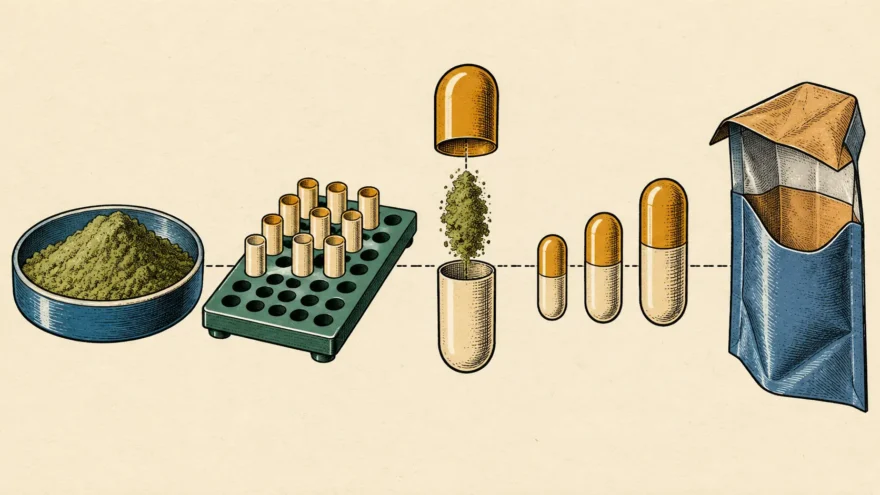
What Are Kratom Capsules?
A kratom capsule is milled kratom leaf inside a hard gelatin shell, and nothing else. No binder, no filler, no flow agent. The question everyone asks is how much leaf is in one, and across this industry the answer is shakier than it sounds. A capsule body is a fixed amount of space, and a filling machine packs that space full. A label reports weight. Space and weight only agree when somebody weighs what came out. Here’s what a capsule size means, why fill weight moves, what a count on a bag is really telling you, and what we found when we weighed four hundred of our own.
What is in a kratom capsule?
A kratom capsule is powder in a shell, and the powder does all the work. Ours are size 00 hard gelatin. Gelatin is collagen taken from animal hide or bone, and it’s been the standard capsule material for a century because it is strong when dry, dissolves in water at body temperature, and tastes like nothing. Some brands use a plant shell instead, made from a cellulose called HPMC.
What the format buys you is that the leaf is already portioned and you never taste it. What it costs you is a shell.
The leaf inside is the same leaf we put in bags of kratom powder, from the same lots, milled to the same 80 mesh. A capsule is a container, not a different product. Which one suits you better has its own page at kratom capsules vs powder. Ours are at buy kratom capsules.
What does a capsule size mean?
Capsule sizes run from 000 down to 5, and the numbering runs backward, so a bigger number means a smaller capsule. A 000 is the largest shell in common use and a 5 is the smallest. Sizes 00 and 0 are the two you’ll meet most, and kratom is almost always a 00.
Here’s the part that matters. A capsule size is a volume, not a weight. A size 00 shell holds 0.90 milliliters. A size 0 holds 0.68. Nothing in that number says how many milligrams go inside, because that depends on what you’re filling it with. A dense mineral powder and a fluffy leaf powder fill the same shell to the same line and land far apart on a scale.
Run the arithmetic on ours and it lands where it should. Five hundred milligrams of leaf in 0.90 milliliters is a packing density near 0.55 grams per milliliter, which is ordinary for milled leaf and nowhere near a pharmaceutical powder. Any brand claiming three quarters of a gram of plain leaf in a 00 is describing a density leaf does not reach.
You can check a size yourself in thirty seconds. Line ten capsules end to end against a ruler. A 00 comes to about 9 1/4 inches (234 mm), a 0 to about 8 1/2 inches (216 mm), and a 000 to about 10 1/4 inches (261 mm). One capsule is a question about a sixteenth of an inch, which no eye can judge. Ten turn it into three quarters of an inch, and a kitchen ruler answers it.
Why does the fill weight vary?
Fill weight varies because a filling machine works in space and a label works in weight. The body of a size 00 shell holds 0.90 milliliters, the same 0.90 every time, and the machine packs that space full. Whatever that volume of that particular powder happens to weigh is the fill weight. Density is the whole story.
We tested it on our own product rather than assuming. We weighed a hundred capsules from each of four colors. The differences were real and bigger than we expected. Heaviest color to lightest ran about eleven percent apart, which is far beyond machine variation and points at the leaf.
One number worth knowing if you ever weigh a capsule yourself. An empty size 00 gelatin shell runs about 130 milligrams on our own scale, so a filled capsule weighs the leaf plus that. It’s the likeliest source of the inflated fill weights floating around this category. Somebody weighs a whole capsule, shell and all, and the number gets printed as though it were the leaf.
Bagging is a separate step and a separate machine, and this is where it lands on the customer. Our bags are filled to a weight rather than counted out. A denser powder takes fewer capsules to reach that weight and a lighter one takes more. Across the four colors the capsule count moved by dozens per bag. The weight of leaf in the bag moved by about two percent. The count is the number that wanders. The product is the number that holds.
What does a capsule count actually tell you?
It depends on how the bag was filled. Our 100 count bags are counted, so 100 means 100. Every other size in our lineup is filled to a weight, so the count is whatever that weight worked out to that day with that lot. A brand printing an exact count on a weight filled bag is either counting every bag by hand or rounding without saying so.
Nobody is going to sit and count out a kilo, and we are not going to pretend somebody might. What we can promise on those sizes is the weight, because the weight is what the scale sets.
Ours read about 700 capsules in a half kilo and about 350 in a quarter, at 500 milligrams of leaf each, with four capsules making the two gram serving on the panel. Those figures are deliberately low. We set them at the bottom of the range so every color clears them, rather than picking a middle that some colors would miss. Count a bag and you should find more than the label promised, not fewer.
Does the shell itself matter?
The shell matters more than people expect, because a capsule has a second job past holding powder. It has to open again.
Gelatin can cross-link, which means its protein chains bond to each other and stop dissolving the way they should. Heat, humidity, ultraviolet light and certain reactive compounds all drive it. The bonding is effectively permanent. It leaves a thin insoluble skin inside the shell, called a pellicle, that can hold the powder in.
Humidity changes a gelatin shell on its own too. A 2025 study put gelatin and HPMC capsules in 75 percent relative humidity and found the gelatin took up moisture at a lower rate but ended up holding more of it, which left those shells softer and easier to puncture.
How often does any of this bite? Nobody has measured it on kratom. The nearest evidence is not reassuring. A 2020 study ran the pharmacopeia’s own disintegration protocol on 28 single ingredient green tea products across multiple lots. Nine always passed, eight always failed, and eleven gave a different answer from one lot to the next. Those were extract capsules rather than plain leaf, so the comparison is imperfect, and it is the closest data anyone has.
One honest correction to all of it. A laboratory disintegration test is a harsher judge than a stomach, and cross-linked capsules that refuse to open in a beaker have been shown to open fine in people. The lesson is about storage rather than alarm, and storage has its own page at does kratom expire.
What did a bad supplier teach us?
Before we landed on our current supplier we bought capsules from several others, and one of them taught us what fill consistency is worth. They arrived wildly uneven. Some were packed tighter than the machine should have managed. Some were half full. A few held almost nothing. Inside a single bag you could feel the difference between one capsule and the next in your hand.
That’s the failure a customer cannot see. Powder shows you its faults in the bag. A capsule hides them behind an opaque shell, and the only way to know is to open one or to buy from someone who checks. We left that supplier over it and we have stayed with the current one since, largely because this is the thing they get right.
What should you check before buying kratom capsules?
Ask what the fill weight is and whether the count is exact or approximate. A seller who can answer has a specification. A seller who can’t has never asked their filler.
Ask for the certificate of analysis on the lot, the same as you would for powder, and read it rather than trusting that it exists. What one holds and how to read it is covered on kratom lab testing.
Check the shell material if that matters to you, since gelatin is an animal product and HPMC is not. And keep them cool and dry, because the shell ages before the leaf does.
A capsule is a container for leaf. How people take them, with every other route, belongs on how to take kratom.
Back to Kratom Forms or to the Kratom Guide.